Mantra Field Books · No. 1
The DescentSri Aurobindo, the Mother, and the city they left behind
Who they were, what they actually taught, and what has become of it — including the parts the Ashram bookshop does not sell.
I lived in Auroville for seven years. That is long enough to stop being a visitor and not nearly long enough to be an authority, and it means this book is written from somewhere rather than from nowhere. I should say so at the start rather than pretend to a neutrality I do not have.
Two people made this. A Bengali revolutionary who was educated entirely in England and could not speak his mother tongue when he returned to India. A French woman from a Sephardic-Egyptian family in Paris who painted, studied occultism in Algeria, and ended up running a spiritual community in Tamil Nadu for forty-seven years. They met in 1914, briefly. She came back in 1920 and never left.
What they built is now three things at once: a body of philosophy that is genuinely original and genuinely difficult; an ashram in Pondicherry with a school and a printing house; and a township of some three thousand people, four hours' drive down the coast from Chennai, which has spent the last five years in a governance conflict serious enough to reach the Supreme Court of India.
This book covers all three. It tries to be exact about the lives, plain about the philosophy, and fair about the conflict — which in practice means giving both sides their own words and refusing to adjudicate a case that is still in court.
The literature around these two is overwhelmingly devotional, and the devotional literature reports events — descents, transformations, physical changes — that no outside method can check. Where I report those, I report them as what devotees record, attributed, and I say so each time. That is not scepticism. It is the only honest register available to somebody writing from outside.
Chapter one
Two beginnings
A boy sent to England at seven, and a girl painting in Paris.
Aurobindo Ghose was born in Calcutta on 15 August 1872. His father, a doctor trained in Britain, had decided that his sons would be raised entirely English, and executed the plan with a thoroughness that is hard to read about comfortably: the boys were sent to England in 1879, when Aurobindo was seven, and placed with an English clergyman's family in Manchester with instructions that they were to receive no Indian influence of any kind.
It worked. He went on to St Paul's School in London and then to King's College, Cambridge, on a scholarship. He read Greek and Latin, wrote poetry in English, and by his own later account arrived back in India at twenty-one unable to speak Bengali. The man who would become the intellectual engine of Indian nationalism had to learn his own language as an adult.
The examination he did not sit
He passed the Indian Civil Service examination — the fiercely competitive route into the imperial administration, and the thing his father wanted. He then failed to present himself for the riding test, and was disqualified.
Whether this was deliberate is a small famous argument. The devotional account has him refusing to serve the empire; the sceptical account has a bookish young man who was bad with horses. The evidence supports a reading somewhere between: he had already joined a student group interested in Indian independence, and he made no serious effort to keep the appointment. Both things can be true.
Mirra
Mirra Alfassa was born in Paris on 21 February 1878, to a Sephardic Jewish family with Egyptian and Turkish roots — her mother Egyptian, her father a Turkish banker. She grew up comfortable, secular and metropolitan, studied painting, and moved in a Paris art world that at one point put her in the company of Rodin and Monet.
She also, from early childhood, had experiences she had no vocabulary for: recurring visions, a sense of a presence she later identified with Krishna, and what she described as leaving the body at night to do work she could not explain. She said later that she found the vocabulary only when she read the Bhagavad Gita in her twenties.
He was born Aurobindo Ghose. "Sri" is an honorific added later; he did not use it of himself for most of his life. She was born Mirra Alfassa, was briefly Mirra Morisset and then Mirra Richard by marriage, and was called the Mother from the mid-1920s onward. In the community she is simply Mother, without the article, and I have kept the article here for readers coming to this cold.
Chapter two
The revolutionary
Baroda, Bande Mataram, and the most dangerous man in India.
He spent roughly thirteen years in Baroda, in the service of the Gaekwad, teaching and administering and reading enormously. He learned Sanskrit, Bengali, Gujarati and Marathi as an adult. He wrote poetry. And he began, quietly, to organise.
By 1906 he had moved to Bengal, into the agitation that followed the partition of the province, and into open political writing. The newspaper Bande Mataram became the voice of the radical wing of the Congress — the wing that wanted complete independence rather than reform, and said so at a time when saying so was a criminal act.
The distinction mattered enormously. The moderates wanted representation within the empire. Aurobindo's position was that independence was not a concession to be requested but a right to be assumed, and that a nation which behaves as though it is free becomes free. He was tried for sedition and acquitted. Lord Minto, then Viceroy, is widely reported to have called him the most dangerous man in India — a line quoted so often it has worn smooth, and which I have not been able to trace to a primary document.
What his nationalism actually was
It is worth being precise, because both his admirers and his critics simplify it.
He described the nation as a living being with a soul, and Indian independence as a spiritual necessity rather than a merely political one. This is genuinely religious nationalism, and reading it in the twenty-first century, with what has since been done in India under that banner, is uncomfortable. It should be uncomfortable. It is also not the same thing as what came later: his conception was explicitly universalist, aimed at India taking a spiritual role for the whole world, and his later writing on the unification of humanity argues for the eventual dissolution of the nation-state.
Both readings are available in the texts. I think the honest position is that his political writing contains a strand which later movements have used, and that using it requires ignoring most of the rest of what he wrote.
Chapter three
Alipore
The bomb case, a year in a cell, and what he says happened there.
In 1908 a bomb intended for a British magistrate killed two English women instead. The investigation swept up the revolutionary network around Aurobindo's brother Barin, and Aurobindo with it. He was arrested and held for roughly a year in Alipore Jail during the trial.
He was acquitted in May 1909. His defence was conducted by Chittaranjan Das, whose closing speech — asking the court to consider how history rather than the present would judge the man in the dock — is one of the set pieces of Indian legal history.
The year inside
What he reports about that year is the hinge of his life, and it is exactly the kind of claim this book has to handle carefully. In the Uttarpara Speech of 1909, delivered shortly after his release, he described the cell as a place where he had a sustained realisation — the presence of Vasudeva, of Krishna, in everything around him, including the walls, the bars, the prisoners and the judge. He said he was told, inwardly, that the work he was to do was not political.
What can be established from outside: he was imprisoned, he was acquitted, and within a year of release he had left politics permanently for a life of yoga in French territory. What cannot be established from outside is what happened in the cell. He said it plainly and repeatedly, and never traded on it. Take it as his testimony, which is what it is.
The Uttarpara Speech is short, it is online in full at the Ashram's own archive, and it is the single best primary document for understanding the turn. Read it before reading anybody's account of it, including mine.
Chapter four
Mirra, before
Paris, Max Théon, Tlemcen — an occult training nobody expected.
The part of the Mother's life that gets least attention is the part that explains most: before India, she had a decade of serious occult training in North Africa, and she was good at it.
In 1905 or thereabouts she encountered the circle around Max Théon — a Polish-born occultist of deliberately obscured origins — and his English wife Alma, who was by most accounts the more remarkable practitioner of the two. Mirra travelled to Tlemcen in Algeria to stay with them, twice, in 1906 and 1907.
What she learned there was technical: conscious exit from the body, movement through what the Théons called the successive worlds, and a discipline of observation applied to inner experience rather than outer. She spoke about this period matter-of-factly for the rest of her life. It is why her later teaching has a practical, almost laboratory quality that Sri Aurobindo's does not — he writes as a philosopher and a poet; she talks like someone describing fieldwork.
Paris, and the group
Back in Paris she ran a small group called Idéa, meeting to study spiritual texts. She married Paul Richard, a lawyer and thinker with his own interest in Indian philosophy, and it was Richard's journey to Pondicherry in 1910 — on French colonial political business — that first brought Aurobindo's name into her house.
She recorded, later, that she had recognised the description immediately: the figure she had been seeing in visions since childhood, whom she called Krishna.
That last sentence is the Mother's own account of her inner life, given decades afterwards. It is not a verifiable event. I include it because it is central to how the community understands the founding, and because leaving it out would misrepresent the record — but it belongs in the same category as the Alipore realisation. Her testimony, offered as such.
Chapter five
The boat to Pondicherry
1910, and the end of the political life.
In February 1910, warned that another prosecution was coming, Aurobindo left Calcutta. He went first to Chandernagore, then a French enclave, and hid there. On 4 April 1910 he arrived in Pondicherry, also French territory, and therefore outside the reach of British Indian law.
He was thirty-seven. He would remain in that town for the remaining forty years of his life, and would leave his own house only a handful of times.
The decision, and the two readings
His political colleagues were bewildered, and some never forgave him. The most effective radical voice in Bengal had walked away at the height of his influence, and the movement lost him permanently.
The devotional reading is that he was called, in the cell, and obeyed. The sceptical reading is that a man facing a second prosecution and possible transportation to the Andamans took a rational exit into French jurisdiction. These are not incompatible, and the insistence that only one can be true says more about the reader than about 1910.
What is not in dispute is what he did with the next four decades. He did not re-enter politics. He did not seek publicity or funds. He wrote, in a small house, on an enormous scale, and a group of people gradually formed around him without his having invited them.
Chapter six
1914, and the Arya
The meeting, and six and a half years of writing that made everything else.
Mirra and Paul Richard arrived in Pondicherry in March 1914. She met Sri Aurobindo on 29 March. She stayed eleven months, and in that time the two of them, with Richard, started a monthly review called the Arya.
Understanding the Arya is the fastest route into understanding the whole edifice, because almost everything Sri Aurobindo is read for today first appeared in it, serialised, month by month, written to a deadline.
Between August 1914 and January 1921, in monthly instalments, he wrote and published The Life Divine, The Synthesis of Yoga, Essays on the Gita, The Secret of the Veda, The Human Cycle, The Ideal of Human Unity, and The Foundations of Indian Culture — several of them simultaneously.
He was writing multiple book-length philosophical works at once, to a fixed monthly page count, in his second language, largely alone. Whatever one concludes about the metaphysics, the sheer productive fact of the Arya is remarkable and is usually skipped.
The war, and the return
The First World War forced the Richards back to France in 1915, and then to Japan, where they spent four years. Mirra returned to Pondicherry on 24 April 1920 and did not leave again. Paul Richard left; the marriage ended.
From that point the work has two authors, and the community's own account is emphatic that the two were doing one thing. That claim is easy to state and hard to examine, because after 1926 he stopped appearing in public and she ran everything.
Chapter seven
The Integral Yoga
What it takes from tradition, and the exact point where it turns around.
Here is the entire departure in one sentence, and everything else is commentary: the classical goal is to get out; this one is to bring something down.
What it inherits
The vocabulary is Vedantic and the debt is real. Brahman as the one reality. Atman, the self, identical with it. The world as it appears being not what it is. Sri Aurobindo read the Upanishads and the Gita closely and wrote extensively on both, and he does not pretend to have invented the ground he stands on.
He also takes from Tantra the insistence that matter and energy are not obstacles but instruments, and he says so — that his yoga begins where Tantra's does, with a refusal to treat the world as an error.
Where it turns
The classical trajectories, whatever their differences, end in release. Advaita's liberation is the dissolving of the appearance of separateness. The Buddha's is the cessation of the process. Patañjali's kaivalya, as the previous field book in this series describes at length, is aloneness — consciousness disentangling from nature and leaving it behind.
Sri Aurobindo accepts that all of these are attainable and that people have attained them. His objection is that they are incomplete, and specifically that they leave the world exactly as they found it. The individual escapes; matter remains unredeemed; the next person starts from the same place.
His proposal is that liberation is the halfway point. Having reached the higher consciousness, the practitioner's actual work is to bring it down — into mind, then into the life-energy, then into the body itself — so that matter is transformed rather than abandoned. He called this the descent, and it gives this book its title.
The four aids, and the one that matters most
The method, as set out in The Synthesis of Yoga, rests on personal effort, the teacher, the scripture, and time. But the operative principle is surrender — and it displaces effort in a way that unsettles people arriving from disciplined traditions. The Mother's formulation of the triple practice is the one most used in the community: aspiration, rejection, surrender. Aspire upward, refuse what pulls down, and hand over the result.
And the honest difficulty
There is no eight-limbed programme here. No mandatory postures, no prescribed breath count, no sequence of stages you can be tested on. Practitioners are told to do their ordinary work as an offering and to let the change come. For some this is liberating. For others it is a system with no handholds, in which it is impossible to know whether anything is happening, and after some years several of the people I knew in Auroville said exactly that. It belongs in an honest account.
Chapter eight
The Supermind
The central claim, stated plainly, without decoration.
Strip the terminology and the claim is this: evolution has not finished, the next step is a change of consciousness rather than of body, and it can be worked on deliberately.
The argument
It runs, in The Life Divine, roughly as follows. Consciousness involved itself in matter — that is what matter is, consciousness at its most concealed. Evolution is that consciousness working its way back out: matter, then life, then mind. Each emergence looked impossible from the stage below it. Nothing in stone predicts a plant; nothing in a plant predicts a thought.
Mind, therefore, is unlikely to be the end of the sequence. And mind has a specific structural limitation: it works by division. It knows things by separating them from other things, which is why it can be endlessly clever and never arrive at unity.
The Supermind is his name for a mode of consciousness above mind which knows by identity rather than by division — not a very clever mind but a different kind of knowing. Between mind and it he maps intermediate ranges: higher mind, illumined mind, intuition, overmind. Most spiritual experience, in his account, comes from those intermediate levels, which is why it illuminates without transforming.
The claim that is genuinely unusual
Plenty of traditions describe higher states. What is distinctive here is the insistence that the supramental consciousness can descend into the physical body and change it — that the eventual result is a divinised body, and that death is not a permanent feature of the arrangement.
This is stated seriously and at length. It is the reason the Mother spent the last thirteen years of her life on what she called the work in the cells of the body, documented in the thirteen volumes of her Agenda.
There is no evidence for supramental transformation of a body, and no method by which I could assess the claim. Both of them died: he in 1950 at seventy-eight, she in 1973 at ninety-five. The community holds that the work continued and succeeded at a level not visible externally. That is an unfalsifiable position, which is not the same as a false one — but it is where an outside account has to put its pen down and say so.
The date the community marks
On 29 February 1956 — a leap day, which the community notes — the Mother recorded that the supramental light and force descended into the earth's subtle-physical atmosphere. It is observed annually as the Golden Day. Note carefully what is claimed: a descent into the earth's subtle physical, not into any individual body, and not a completed transformation. The distinction is routinely lost by outside writers, and getting it wrong makes the community's own position look sillier than it is.
Chapter nine
24 November 1926
The day he withdrew and she took the Ashram.
The community calls it Siddhi Day, or the Day of Victory. It is the founding date of the Sri Aurobindo Ashram, and it is also the day Sri Aurobindo effectively disappeared.
What is recorded: on that evening he told the assembled group — around two dozen people — that a descent had occurred, which he described as the Krishna consciousness coming down into the physical. He then announced that he was withdrawing into seclusion to work, and handed the entire charge of the group to Mirra Alfassa, who from that point was called the Mother.
Twenty-four years behind a door
He kept to it with a completeness that is hard to overstate. From 1926 until his death in 1950 he did not give public talks, did not travel, and appeared before the community only on four darshan days a year, in silence. Everything else went through her, and his contact with the outside world was almost entirely by letter — thousands of them, to disciples, on every conceivable question of practice, later collected as the Letters on Yoga.
What she actually did
This is where the community's founding and the outside world's picture diverge most sharply. The picture is of a spiritual figurehead. The reality was closer to a working chief executive with a mystic's vocabulary.
She ran the Ashram's finances. She organised its kitchens, its housing, its laundry, its dairy. She founded and directed a school — later the Sri Aurobindo International Centre of Education — with a curriculum of her own design in which children were not graded and not made to compete. She oversaw a printing press, an art department, a workshop, and eventually a physical education programme so serious that Ashram athletes competed at state level.
Forty-seven years of administration. It is the least mystical and most impressive fact about her, and it is why the place still stands.
Chapter ten
Savitri, and how to enter it
Twenty-four thousand lines, and where to start.
Savitri: A Legend and a Symbol runs to roughly twenty-four thousand lines of blank verse, which makes it one of the longest poems in English. He worked on it for decades, revising continuously, and completed the final portions in his last years by dictation when his eyesight had failed.
The frame is a short episode from the Mahabharata: Savitri marries Satyavan knowing he is fated to die within a year, and when Death comes she follows and argues him back. Sri Aurobindo uses it as a vehicle for the whole cosmology — Aswapati's ascent through the worlds occupies an enormous central section, and Savitri's confrontation with Death is the poem's argument stated as drama.
Reading it, practically
Most people who try to read Savitri from page one stop somewhere in Book Two. It is not a narrative poem with a slow opening; it is a cosmology with a narrative attached, and the story does not resume for a very long time.
- Do not start at the beginning. Start with Book Four, the Book of Birth and Quest, where Savitri herself enters and the verse becomes narrative.
- Read it aloud. It was composed by ear and much of it does not work silently.
- Take single passages. The community's own practice is to read a page at a time, slowly, and this is a reasonable way in rather than a piety.
- Expect the metaphysics to be doing real work. The descriptions of the subtle worlds are not decoration; they are the same map set out in prose in The Life Divine.
And The Life Divine
The prose masterwork is genuinely difficult, and the difficulty is not obscurity — the sentences are long, precise and Victorian, and they repay slow reading. The standard advice, which I think is right, is to read the first two chapters, then jump to the chapters on the individual topic you actually came for, and return to the systematic argument later if it still appeals.
Chapter eleven
The two deaths
1950 and 1973, and what each one changed.
Sri Aurobindo died on 5 December 1950, aged seventy-eight, of what was diagnosed as uraemia. The Mother died on 17 November 1973, aged ninety-five.
1950
The death was not expected by the community, and for a movement whose central claim included the transformation of the body it posed an obvious problem. The Mother's account, given afterwards, was that he had chosen to leave the body deliberately — that the work required a sacrifice, and that he made it so that the process could continue through her.
This should be stated for what it is: a theological interpretation offered after the event by the person who inherited the authority. It may be true. It is also exactly what a movement in that position would need to be true, and a reader is entitled to hold both thoughts.
What is verifiable is a change in the community's shape. He had been silent behind a door for twenty-four years; now the door was empty, and she was, unambiguously, the centre.
1973
The second death was harder, because there was no successor and she had not appointed one. She had spent her final years in near-total seclusion, working on what she described as the transformation of the body's cells, with the conversations recorded by the disciple Satprem and published as the Agenda.
After November 1973 the movement had no living authority, only texts. Everything that has happened since — in the Ashram, in Auroville, in the trusts and the court cases — happens in the space that left. It is difficult to overstate how much of the later conflict traces back to a simple structural fact: they built no mechanism for deciding anything after they were gone.
Chapter twelve
A city with no money and no religion
Auroville 1968: the charter, the urn, the Galaxy, the Matrimandir.
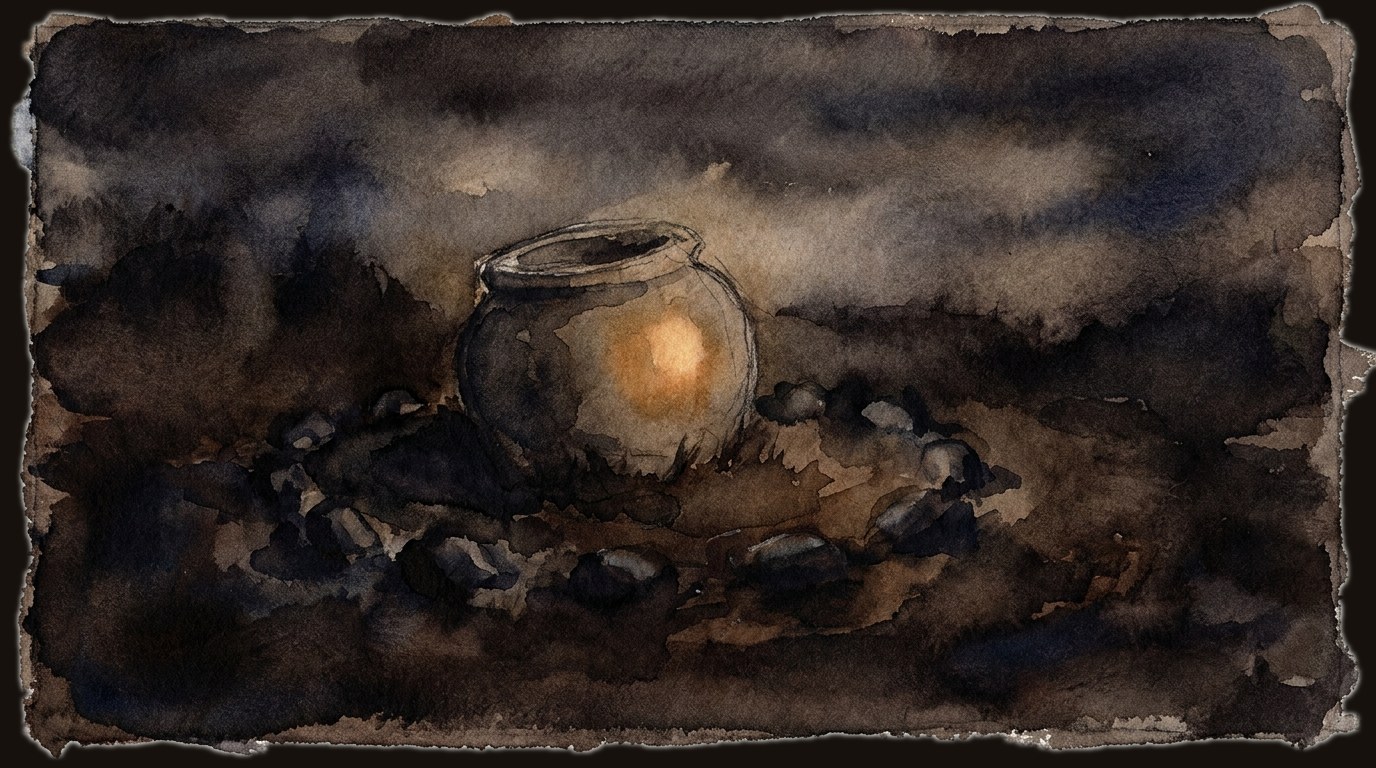
On 28 February 1968, on an eroded red plateau north of Pondicherry, a girl read the Auroville Charter in French while representatives of 124 nations and the Indian states poured handfuls of their soil into a marble urn. There was almost nothing there: the land had been farmed and grazed to hardpan, and the water table was falling.
The Charter, in four lines
It is very short, and every subsequent argument is an argument about how to read it.
- Auroville belongs to nobody in particular; it belongs to humanity as a whole. To live in it one must be a willing servitor of the Divine Consciousness.
- It will be the place of an unending education, of constant progress, and a youth that never ages.
- It wants to be the bridge between the past and the future, taking advantage of all discoveries from without and from within.
- It will be a site of material and spiritual researches for a living embodiment of an actual human unity.
Note what is absent: no governance mechanism, no membership criteria, no property law, no procedure for resolving a disagreement. The Charter is a statement of intent, and it was never anything else.
The Galaxy
The physical plan came from the French architect Roger Anger: a spiral city in four zones — residential, cultural, industrial, international — wrapped around a centre, with an inner ring road called the Crown and twelve radial roads, all within a Green Belt. The Mother's stated target population was fifty thousand.
Remember that number. Nearly sixty years later the population is around three thousand, and the gap between the drawing and the reality is the engine of the conflict in the next chapter.
The Matrimandir
At the centre, a golden sphere. Foundation laid in 1971; construction ran for decades on volunteer and donated labour; the inner chamber — white marble, no images, no ritual, a single crystal receiving a shaft of sunlight through the roof — opened in the 1980s, and the structure was completed in 2008.
The Mother was explicit that it was not a temple and that there should be no religion in it. That instruction has been kept remarkably well.
The forest
The achievement nobody disputes. Aurovilians and Tamil villagers planted, by most accounts, something on the order of two million trees on that dead plateau, built bunds and check dams, and reversed the erosion. The groundwater came back. The dry evergreen forest that now covers much of Auroville did not exist in 1968 and was made by hand.
This matters enormously for what follows, because the trees that the Crown Road runs through are not scenery. They are the thing the first generation actually built.
Chapter thirteen
What Auroville is now
The numbers, the Act, and a conflict currently before the courts.
This chapter is about a live dispute in which I know people on both sides. I am going to give the numbers, the legal structure, and each side's own position in its own terms, and I am not going to tell you who is right.
The numbers
| Item | Figure |
|---|---|
| Population, end of 2021 (Auroville's own count) | 3,286 including newcomers and children |
| Gender split, same count | 1,642 men · 1,644 women |
| Largest nationalities | India 1,504 · France 459 · Germany 260 · Italy 176 |
| The Mother's target | 50,000 |
| Crown Road length | ~4.3 km, right of way 16.07 m |
| Trees felled, Bliss and Darkali, Dec 2021 (reported) | 898, across 44 species |
The legal structure
After an earlier crisis in the late 1970s between residents and the Sri Aurobindo Society, the Indian government intervened, and eventually the Auroville Foundation Act 1988 placed the township under a statutory body with three organs:
- the Governing Board, appointed by the central government, responsible for administration and development;
- the Residents' Assembly, all the residents, with defined functions including admissions and terminations;
- the International Advisory Council.
A government-appointed Secretary runs the Foundation office. By all accounts this arrangement worked collaboratively for about three decades.
What happened
A new Secretary, Jayanti Ravi, took office in July 2021. In December 2021 the Auroville Town Development Council began clearing the right of way for the Crown Road. On 4 December trees were felled at night; on 9 December excavators arrived at the Youth Centre to demolish it. Residents physically obstructed the work. The National Green Tribunal granted an interim stay on 10 December 2021 and a further stay in April 2022.
From there it became a governance conflict rather than a road dispute. Standing Order 01/2022 reconstituted the ATDC. The Foundation established its own working groups in parallel with the Residents' Assembly's. In December 2023 new admission and termination regulations gave Governing Board appointees control over who joins and leaves.
The courts, in order
- 12 August 2022 — Madras High Court upholds the collaborative reading of the Act.
- 15 March 2024 — Madras High Court finds the Governing Board and Secretary had unlawfully seized powers and disenfranchised the Residents' Assembly.
- March 2025 — the Supreme Court, in Auroville Foundation v. Natasha Storey, overturns the High Court on Standing Order 01/2022 and holds that neither the Act nor the 1997 Rules give the Residents' Assembly or any individual resident a right to sit on committees constituted by the Governing Board.
- 2026 — parallel sets of working groups continue to operate, further matters remain before the courts, and in June 2026 a group of residents held a public meeting in Chennai to raise concerns about self-governance and ecology.
The two positions, each in its own terms
The Mother specified a city of fifty thousand and a physical plan. Fifty-seven years later there are around three thousand people and the Master Plan — approved by the Government of India in 2001 — is largely unbuilt. A statutory body has a duty to implement it. Residents have no legal right to veto development, as the Supreme Court has now confirmed, and prolonged consultation has produced decades of delay.
The Act's structure is collaborative and the Foundation has bypassed it, creating shadow bodies and taking control of admissions in a way the Act reserves to the Residents' Assembly. Auroville's actual achievement is the forest and the experiment in self-organisation, both of which are being destroyed to build a 1968 drawing. Residents' groups cite their own polls — reported as 97% of nearly 1,200 residents opposing the administration's methods in 2022, and 98% of 945 voting against the Secretary's land deals in 2024 — against official characterisations of the opposition as a small minority.
Two things are worth saying plainly. Those poll figures come from residents' organisations and I have not seen them independently audited; I report them as their claim. And the deepest disagreement is not procedural at all — it is whether the Mother left a blueprint to be executed or an experiment to be conducted. Both sides quote her, accurately, and reach opposite conclusions.
Chapter fourteen
Heritage, and the fight over the story
Influence, criticism, and what happened when a biographer told it straight.
The influence is real and diffuse rather than institutional. Sri Aurobindo's evolutionary framework runs through the integral theory of Ken Wilber and through a good deal of transpersonal psychology, sometimes credited and sometimes not. The Mother's school shaped a strand of alternative education in India. Auroville's reforestation is cited seriously in dryland restoration work.
The criticisms worth taking seriously
- The unfalsifiability problem. The central claim — supramental transformation — is arranged so that no outcome could disconfirm it. When transformation does not visibly occur, the answer is that it is proceeding at a level not externally visible.
- The prose. The Life Divine is long, repetitive and written in a register that was already old-fashioned in 1918. Some readers find this necessary to the subject; others reasonably find it an obstacle.
- The nationalism. Discussed in chapter two. The strand exists, and its later uses are not his fault but are not unrelated either.
- The devotional culture. Around any figure like this, an apparatus grows in which quoting settles arguments. It is fair to observe that this is at odds with a teaching whose central instruction is to verify in your own experience.
The Heehs affair
In 2008 Peter Heehs — an American who had lived and worked in the Ashram archives for decades and co-founded them — published The Lives of Sri Aurobindo with Columbia University Press. It is a scholarly biography: sympathetic, careful, and written in the ordinary historical register, which meant treating the visions as reported experience rather than as established fact.
The reaction from parts of the community was ferocious. There were petitions, litigation in Indian courts, sustained attempts to have the book blocked in India, and a long campaign over his residency status. Other members of the community defended him publicly, and the affair split the Ashram world for years.
I raise it because it is the sharpest available illustration of the tension this whole book sits inside. A movement founded on individual verification and hostile to religion produced, within sixty years, a faction that tried to suppress a biography for declining to write in the devotional voice. That is not an argument against the philosophy. It is a fact about what happens to philosophies, and it is exactly the kind of thing an honest field book should not leave out.
What I actually think, said once
The metaphysics I cannot verify and will not pretend to. What I can say from seven years there is narrower and, to me, more interesting: a group of people took a dead plateau and made a forest on it, built a school where nobody is ranked, and ran an experiment in living without private property for half a century. Whether or not a supramental consciousness is descending, those things happened, they were hard, and they were done by people who believed the first thing in order to do the second.
Apparatus
Sources
What was read, both sides, with dates.
Primary
- Sri Aurobindo — The Life Divine; The Synthesis of Yoga; Savitri: A Legend and a Symbol; Essays on the Gita; The Human Cycle; The Ideal of Human Unity; Letters on Yoga; the Uttarpara Speech (1909). All serialised or collected from the Arya, August 1914 – January 1921, and available in the Sri Aurobindo Ashram's complete works.
- The Mother — Collected Works; Questions and Answers; Mother's Agenda (13 vols, recorded by Satprem).
- The Auroville Charter (28 February 1968) and the Auroville Foundation Act, 1988, with the Auroville Foundation Rules, 1997.
Biography and scholarship
- Peter Heehs — The Lives of Sri Aurobindo (Columbia University Press, 2008). The standard scholarly biography, and the subject of chapter fourteen.
- Sri Aurobindo — Autobiographical Notes and Other Writings of Historical Interest, where he corrects accounts of his own life.
On the Auroville conflict — read both
- Auroville Foundation v. Natasha Storey, Supreme Court of India, March 2025 (2025 INSC 348), Trivedi and Varale JJ. Reported by SCC Online and analysed by CaseMine.
- Madras High Court judgments of 12 August 2022 and 15 March 2024.
- Residents' side: auroville.media — summary of the crisis and the quarterly bulletins; Auroville Today archive at auroville.today, including its account of the pending court cases.
- Press: The Print, Auroville is having a Crown headache (2022); Mongabay India, Environmental conflict threatens iconic Auroville; The Federal; The Quint on the NGT stays; The News Minute, June 2026, on the Chennai residents' meeting.
- National Green Tribunal, Southern Bench — interim stay 10 December 2021, further stay 29 April 2022.
All web sources consulted 20 August 2026. Where the residents' organisations and the Foundation describe the same event differently, both descriptions are given in chapter thirteen and neither is presented as settled.
House rule
What I could not verify
Stated as plainly as what I could.
- Every inner event in this book is testimony, not evidence. The Alipore realisation, the Mother's childhood visions, the 1926 descent, the 1956 Golden Day, the work in the body's cells. I have marked them as such at each point and I mark them again here.
- The Minto quotation — "the most dangerous man" — is repeated everywhere and I could not trace it to a primary document. Treat it as tradition.
- The two-million-trees figure for Auroville's reforestation is the commonly cited one and I have not found an audited source for it. The reforestation itself is not in doubt; the number is approximate.
- The residents' poll figures (97% of ~1,200 in 2022; 98% of 945 in 2024) come from residents' organisations. I have not seen independent verification and have attributed them accordingly.
- The 898 trees felled in December 2021 is a press-reported figure, not a court finding.
- Population figures are Auroville's own count for end-2021. Wikipedia gives 3,300 and one press account 3,305 for roughly the same period. I have not found a reliable 2026 figure and have not invented one.
- The court position is a moving target. Matters were still pending when this was written on 20 August 2026, and anything here may have been superseded. Check before relying on it.
- I did not read the Supreme Court judgment in full — I worked from legal reporting of it. That is a real limitation on chapter thirteen.
- I am not neutral. Seven years in Auroville, and friends on both sides of the current conflict. I have tried to give each position in its own words rather than in mine, but somebody from either camp would write this chapter differently.